
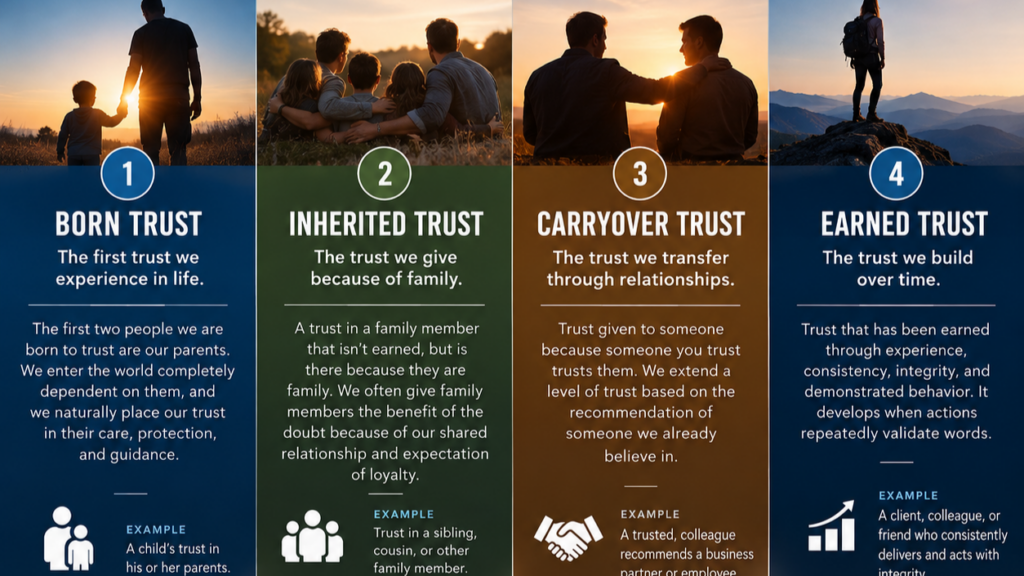
Understanding Earned Trust, Carryover Trust, Inherited Trust, and Born Trust
“We often say trust must be earned. But if that were entirely true, how do we explain the people we trusted before they ever had an opportunity to earn it?”
I’ve spent a considerable amount of time thinking about trust, particularly as it relates to leadership, business relationships, family, and the people we allow into our lives.
Trust is one of the most powerful forces in human relationships. It influences whom we follow, whom we hire, whom we believe, and whom we allow to influence our decisions.
Yet I’ve come to believe that we often oversimplify trust by treating it as though it develops the same way in every relationship.
It doesn’t.
Over time, I’ve developed a framework that I call The Four Levels of Trust.
These four levels are:
- Earned Trust
- Carryover Trust
- Inherited Trust
- Born Trust
Each represents a different way trust enters a relationship. Understanding those differences can fundamentally change how we approach leadership, relationships, and accountability.
1. Earned Trust: The Trust We Build
Earned Trust is perhaps the most familiar and universally understood form of trust.
It develops through experience, consistency, integrity, and demonstrated behavior over time.
Someone tells you they will do something, and they do it.
Someone makes a commitment, and they honor it.
Someone faces a difficult decision, and you watch them choose integrity over convenience.
Little by little, trust develops.
In business, this is the foundation of many successful relationships.
A client doesn’t necessarily trust a consulting firm because of its website, credentials, or impressive presentation. Trust develops when the firm consistently delivers on its commitments, communicates honestly, and demonstrates that the client’s interests matter.
I’ve seen this firsthand throughout my career.
Some of the strongest professional relationships I’ve developed were not established during successful projects. They were established during difficult projects when circumstances were challenging, decisions were uncomfortable, and people had to demonstrate who they really were.
Earned Trust is built when actions repeatedly validate words.
It is also important to recognize that Earned Trust can take years to develop and moments to damage.
And once damaged, rebuilding it can be far more difficult than establishing it in the first place.
2. Carryover Trust: The Trust We Transfer
Carryover Trust is particularly interesting because it doesn’t begin with our own experiences.
Instead, it begins with someone else’s.
Imagine a longtime friend or respected colleague introduces you to someone and says:
“I’ve worked with this person for years. You can trust them.”
Before that individual has done anything to demonstrate their trustworthiness to you personally, you have already extended them a certain level of trust.
Why?
Because someone you trust trusts them.
Carryover Trust is trust transferred through an existing trusted relationship.
We see this constantly in business.
A CEO recommends a consultant to another CEO.
A trusted employee refers someone for an important position.
A client introduces a service provider to another organization.
In each situation, the new relationship begins with a level of credibility that would otherwise take months or years to establish.
However, Carryover Trust introduces an interesting responsibility.
When someone recommends you, they are effectively lending you a portion of their reputation.
Your actions can either validate that recommendation or damage the credibility of the person who made it.
That’s why I believe referrals are among the greatest compliments someone can give in business.
They’re not simply introducing two people.
They’re placing their own trust on the line.
But Carryover Trust has an expiration point.
Eventually, the person receiving that trust must establish their own record of credibility.
Carryover Trust opens the door. Earned Trust determines whether that door stays open.
3. Inherited Trust: The Trust We Give Because of Family
Inherited Trust is different from both Earned Trust and Carryover Trust.
This is the trust we extend to someone because of a family relationship.
Think about the trust we often place in siblings, cousins, grandparents, aunts, uncles, or other relatives.
In many cases, these individuals receive a level of trust simply because they are family.
They may not have demonstrated the same consistency or reliability we would require from someone outside the family.
Yet we give them the benefit of the doubt.
Why?
Because family relationships create an expectation of loyalty, protection, and shared responsibility.
We often assume that someone who shares our family connection will act in our best interests.
Of course, this assumption is not always correct.
Family members can disappoint us, betray our confidence, or violate the trust we’ve extended.
And this raises an important question:
Should family relationships automatically guarantee continued trust?
My perspective is that family may provide the starting point for trust, but it should not eliminate accountability.
Inherited Trust explains why trust is initially extended. It does not guarantee that trust will remain.
In some ways, this may be one of the most emotionally complicated forms of trust because when it is broken, the damage often extends beyond the immediate situation.
It can affect entire family relationships and even future generations.
4. Born Trust: The Trust We Begin Life With
Born Trust is what I consider the most foundational form of trust.
Before we understand credibility, honesty, integrity, or accountability, we enter the world completely dependent upon others.
For many of us, the first two people we are naturally positioned to trust are our parents.
We don’t interview them.
We don’t evaluate their qualifications.
We don’t ask for references.
We simply enter the world needing their protection, nourishment, and care.
That dependence creates the earliest foundation upon which trust can develop.
I call this Born Trust.
Unlike Earned Trust, it doesn’t begin with a track record.
Unlike Carryover Trust, it isn’t transferred through someone else’s recommendation.
And unlike Inherited Trust, it isn’t based on a conscious understanding of family relationships.
It begins with the vulnerability and dependence of a newborn child.
Of course, not everyone experiences the same family structure or parental care. Some children are raised by adoptive parents, grandparents, or other caregivers. And not every parent proves worthy of the trust placed in them.
But the principle remains.
Born Trust represents our earliest dependence on the people responsible for our care, before we have the ability to evaluate whether that trust is deserved.
As we grow older, our experiences with those caregivers help shape how we understand trust in other relationships.
For some, those early experiences establish a strong foundation.
For others, they create challenges that can take years to overcome.
That is why I believe Born Trust deserves special attention.
It reminds us that trust is not always a conscious decision.
Sometimes, it begins before we even understand what trust means.
The Most Important Distinction: How Trust Begins Versus How Trust Survives
As I’ve reflected on these four levels, I’ve come to an important conclusion.
Trust may begin in four different ways, but its survival ultimately depends on behavior.
Think about it.
Earned Trust is established through demonstrated actions.
Carryover Trust must eventually become Earned Trust.
Inherited Trust must be reinforced through actions if it is going to remain healthy.
And Born Trust must be nurtured through consistent care, protection, and reliability.
This means that although trust can originate from different sources, no relationship should assume that trust is permanently guaranteed.
A family connection doesn’t excuse dishonesty.
A respected recommendation doesn’t excuse poor performance.
A leadership title doesn’t automatically establish credibility.
And years of demonstrated integrity don’t make someone incapable of breaking trust.
The origin of trust explains why we initially extend it.
Our actions determine whether we deserve to keep it.
What These Four Levels Mean for Leadership
I believe this framework has significant implications for organizational leadership.
Consider a new executive joining a company.
That individual may arrive with Carryover Trust because a respected board member recommended them.
They may possess Earned Trust from previous professional relationships.
In a family-owned business, they might even benefit from Inherited Trust.
But none of those automatically establishes lasting trust with the employees they now lead.
That must be developed through behavior.
This is where I believe many leaders make a mistake.
They confuse authority with trust.
A title gives someone the authority to make decisions.
It does not necessarily give them the trust of the people affected by those decisions.
Likewise, a successful reputation may create an opportunity to lead, but that reputation cannot substitute for demonstrating integrity within a new organization.
The leaders I’ve respected most throughout my career understood this distinction.
They didn’t demand trust because of their position.
They demonstrated why they deserved it.
They communicated openly.
They accepted accountability.
They stood behind their people when circumstances became difficult.
And perhaps most importantly, they understood that trust was not something they could simply withdraw from their past accomplishments whenever they needed it.
It had to be continually reinforced.
Trust Is a Responsibility, Not an Entitlement
There is one final observation I would make about these four levels.
We spend considerable time discussing whether other people deserve our trust.
Perhaps we should spend just as much time asking whether we deserve theirs.
If someone gives us Earned Trust, are we continuing to honor it?
If someone extends Carryover Trust because of a recommendation, are we protecting the reputation of the person who introduced us?
If someone gives us Inherited Trust because we are family, are we treating that relationship with the respect it deserves?
And if a child places Born Trust in us as a parent or caregiver, are we demonstrating through our actions that their dependence is safe in our hands?
These are not merely philosophical questions.
They are questions of character.
Because trust is never just about what we receive from someone else.
It is also about the responsibility we accept when someone places their confidence in us.
Final Thoughts
I developed these four levels because I believe trust is more complex than the familiar statement, “Trust is earned.”
Sometimes it is earned.
Sometimes it is transferred.
Sometimes it is inherited.
And sometimes it begins at birth.
But regardless of where trust originates, we should never confuse being given trust with being entitled to keep it.
Trust may be given freely, transferred through relationships, inherited through family, or developed over time. But lasting trust must always be supported by our actions.
And perhaps that is the greatest leadership lesson of all.
You don’t get to decide how much someone trusts you. You only get to decide how you behave with the trust they’ve given you.
I’d be interested in hearing how others view this framework. Do you believe all trust must ultimately be earned, or are there relationships where trust exists independently of our actions?