
The most expensive ERP isn’t necessarily the best. The most popular ERP isn’t necessarily the right one. And the ERP that works for your competitor might be completely wrong for your organization.
Over the years, I’ve been involved in numerous ERP implementations, assessments, and recovery projects across industries including manufacturing, life sciences, distribution, and retail.
One question that comes up repeatedly is:
“Which ERP system is the best?”
My answer is usually another question:
“Best for what?”
It’s a simple question, but one that organizations often overlook when making one of the largest technology investments they’ll ever undertake.
The reality is that ERP systems are not created equal, and choosing the wrong one can create years of operational challenges, unnecessary customization, frustrated employees, and millions of dollars in avoidable costs.
Let’s explore why.
1. ERP Systems May Look Similar, but They’re Not the Same
At a high level, most enterprise resource planning systems offer similar core functionality:
- Financial Management and Accounting
- Procurement and Purchasing
- Inventory and Warehouse Management
- Supply Chain Management
- Manufacturing and Production
- Sales and Order Management
- Reporting and Analytics
Looking at a vendor’s presentation, you might conclude that Microsoft Dynamics 365, SAP, Oracle, Infor, and other ERP solutions essentially accomplish the same things.
And at a very high level, they do.
But the difference isn’t necessarily what they do. It’s how they do it, how well they support your business processes, and what it takes to make them work for your organization.
For example, a manufacturer producing highly regulated pharmaceutical products has fundamentally different requirements from a company distributing consumer products.
Both organizations may need inventory management.
However, one might require:
- Electronic batch records
- Lot genealogy and traceability
- Strict quality controls
- Validated processes and systems
- Regulatory compliance
- Controlled manufacturing environments
The other might prioritize:
- High-volume order processing
- E-commerce integration
- Warehouse automation
- Demand forecasting
- Efficient fulfillment and shipping
Both need an ERP.
But should they necessarily use the same one?
Not without evaluating their requirements first.
2. Your Industry Matters More Than You Think
One of the mistakes I see organizations make is selecting an ERP based on brand recognition rather than industry fit.
A CFO might be familiar with SAP from a previous organization.
A CIO might prefer Microsoft Dynamics 365 because of its integration with the Microsoft ecosystem.
An implementation partner might recommend the platform their consultants know best.
None of those considerations is inherently wrong.
But familiarity and vendor preference should never outweigh business requirements.
Consider a few examples.
Manufacturing
Manufacturers need to understand how an ERP supports production scheduling, bills of materials, shop-floor operations, capacity planning, quality management, and inventory control.
Even within manufacturing, process manufacturing and discrete manufacturing can have dramatically different requirements.
Life Sciences and Pharmaceuticals
These organizations often require sophisticated traceability, quality management, regulatory controls, and validation practices.
An ERP that works beautifully for a general distributor may require significant additional capabilities to operate effectively in a regulated pharmaceutical environment.
Retail and E-commerce
Retail organizations may prioritize omnichannel sales, inventory visibility, promotions, returns, and integration with online marketplaces.
Speed, transaction volume, and customer experience become major considerations.
Chemical Manufacturing
Chemical manufacturers may need formula management, potency calculations, batch tracking, hazardous-material handling, and specialized regulatory reporting.
A platform that lacks these capabilities could require substantial customization or specialized third-party applications.
The point?
Industry alignment should be a major factor in ERP selection, not an afterthought.
3. The Biggest ERP Mistake May Happen Before You Select the Software
Here’s something I’ve said many times during ERP assessments:
“If you don’t understand your business processes, how can you possibly know which ERP is right for you?”
Too often, organizations begin their ERP journey by inviting vendors to demonstrate their products.
The vendors show impressive dashboards, automated workflows, artificial intelligence, and beautiful reporting capabilities.
Executives become excited about what they see.
But there’s a problem.
Nobody has adequately documented how the business actually operates.
Before evaluating an ERP, organizations should understand:
- Their current business processes
- Existing operational inefficiencies
- Critical business requirements
- Regulatory and compliance obligations
- Integration dependencies
- Reporting and data requirements
- Future growth plans
- Opportunities for process standardization
Without this information, you’re not really selecting an ERP based on your business needs.
You’re selecting one based on a sales presentation.
And those are two very different things.
4. Don’t Confuse ERP Capabilities With Implementation Partner Capabilities
This is an important distinction that doesn’t receive enough attention.
A great ERP implemented poorly can become a disaster.
Likewise, an experienced implementation partner can help an organization achieve significant value from a platform that may not be the largest or most recognizable in the marketplace.
When evaluating ERP solutions, organizations need to assess two separate things:
The software itself: Does the platform support our business requirements, scale, integrations, controls, and long-term strategy?
The implementation partner: Does the partner understand our industry, business processes, regulatory environment, and operational challenges?
I’ve seen organizations become so focused on selecting the software that they spend insufficient time evaluating the team responsible for implementing it.
And I’ve seen organizations select implementation partners based largely on price, only to discover later that critical industry knowledge was missing.
Remember, the software vendor and implementation partner are not necessarily the same organization.
Both decisions matter.
5. Customization: The Hidden Cost of Selecting the Wrong ERP
One of the clearest warning signs during an ERP evaluation is the phrase:
“We can customize the system to do that.”
Now, customization isn’t inherently bad.
Nearly every complex ERP implementation involves some level of configuration, integration, or extension.
But there’s a significant difference between making reasonable adjustments to support your business and fundamentally changing the software because it wasn’t designed for your industry.
When customization becomes excessive, organizations can experience:
- Increased implementation costs
- Longer project timelines
- More complex testing requirements
- Higher ongoing support costs
- Difficulties adopting future upgrades
- Greater dependency on specialized resources
Sometimes customization is necessary because a process creates genuine competitive differentiation.
Other times, it’s necessary because the organization selected the wrong platform or refuses to reconsider an outdated process.
The objective shouldn’t be to make an ERP replicate everything your legacy system does. It should be to determine which processes create value and which ones need to change.
That’s where business transformation becomes just as important as technology implementation.
6. The Cheapest ERP Can Become the Most Expensive
Organizations understandably focus on licensing and implementation costs.
But the initial price tag doesn’t tell the entire story.
Consider two hypothetical ERP solutions.
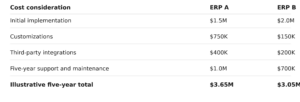

These are hypothetical figures for illustration, not actual vendor pricing or a complete total-cost-of-ownership model.
ERP A looked significantly less expensive at the beginning.
But ERP B ultimately delivered a lower cost over five years.
And this doesn’t even account for potential differences in operational efficiency, implementation risk, employee productivity, or business disruption.
When evaluating ERP platforms, the conversation needs to shift from initial purchase price to total cost of ownership and expected business value.
A lower implementation quote doesn’t necessarily represent a better investment.
7. Should You Change Your Business to Fit the ERP?
This is where the discussion becomes interesting.
Some organizations believe their ERP should adapt entirely to their existing processes.
Others believe they should adopt the ERP’s standard functionality wherever possible.
I believe the right answer is somewhere in the middle.
If your current process exists simply because that’s how you’ve always done things, you should absolutely challenge it.
However, if a process provides a meaningful competitive advantage, supports regulatory compliance, or addresses a critical business requirement, forcing it into a standard ERP workflow may not make sense.
The key is understanding the difference.
You shouldn’t customize an ERP to preserve inefficiency. But you also shouldn’t eliminate a competitive advantage simply because the software doesn’t support it out of the box.
These decisions require business leadership, not just IT leadership.
8. Don’t Forget the People Who Will Actually Use It
An ERP can satisfy every technical requirement and still fail to deliver the expected business value.
Why?
Because people ultimately determine whether the organization successfully adopts the new system.
A warehouse employee, production supervisor, accountant, and customer service representative all interact with ERP systems differently.
If the selected solution makes everyday work unnecessarily difficult, the organization may experience workarounds, inconsistent data, lower productivity, and resistance to adoption.
This is why Organizational Change Management (OCM), training, and business process ownership need to be considered during ERP selection, not just during implementation.
A technically successful go-live doesn’t automatically mean the business has achieved a successful transformation.
The real measure is whether the organization operates better because of the investment.
9. ERP Selection Should Be a Business Decision, Not an IT Purchase
One of my strongest beliefs is that ERP selection should never be owned exclusively by IT.
IT plays a critical role in evaluating architecture, security, integrations, scalability, and technical capabilities.
But the business must own the operational requirements and expected outcomes.
Finance needs to understand how the system supports financial controls and reporting.
Operations needs to understand how it supports production, fulfillment, and efficiency.
Supply Chain needs to evaluate inventory, procurement, and logistics capabilities.
Quality and Regulatory teams need to evaluate applicable compliance requirements.
And executive leadership needs to determine whether the investment supports the organization’s long-term strategy.
An ERP touches nearly every part of the business.
Its selection should reflect that reality.
10. What Would I Recommend Before Selecting an ERP?
If I were advising an organization preparing to replace its ERP, I would recommend five steps before committing to a platform.
Step 1: Conduct a current-state assessment.
Understand your existing processes, systems, inefficiencies, and operational pain points.
Step 2: Define your future state.
Determine what the business needs to look like three to five years from now. Don’t simply recreate today’s environment.
Step 3: Develop measurable business requirements.
Separate mandatory requirements from preferences. Identify critical industry-specific capabilities and integration needs.
Step 4: Evaluate multiple ERP solutions against the same criteria.
Require vendors to demonstrate how their systems handle your actual business scenarios, not just generic product functionality.
Step 5: Independently evaluate the implementation approach and partner.
Assess industry expertise, delivery methodology, resource qualifications, project governance, change management, and total cost of ownership.
And I would strongly recommend involving an independent advisor who isn’t financially motivated to recommend one particular ERP platform or implementation partner.
An independent perspective can help challenge assumptions before they become expensive commitments.
Final Thoughts: The Best ERP Is the One That Fits Your Business
I’ve worked with Microsoft Dynamics 365, Oracle, Infor, and other enterprise platforms throughout my career.
Each has strengths.
Each has limitations.
And each can be the right solution under the right circumstances.
But I’ve never believed that one ERP is universally the best choice for every organization.
The best ERP isn’t necessarily the one with the most features, the largest customer base, or the most recognizable name.
It’s the one that best supports your business requirements, your industry, your people, and where your organization wants to go.
At 365 Digital Technologies, we believe successful ERP initiatives begin with understanding the business before recommending the technology.
Because selecting the right ERP is important.
But understanding why you’re selecting it is even more important.
I’d Like to Hear Your Perspective
For those who have led or participated in ERP selections and implementations:
Do you believe most major ERP platforms can be configured to support almost any business, or do you believe industry-specific functionality should drive the selection from the beginning?
And perhaps the bigger question:
Have you ever seen an organization select the wrong ERP and then spend years trying to make it fit?
I’d be interested in hearing your experiences.
365 Digital Technologies Ltd. Co. We solve your problems so you can run your business.
#ERP #ERPSelection #DigitalTransformation #MicrosoftDynamics365 #SAP #OracleERP #Infor #BusinessTransformation #ERPImplementation #ProjectManagement #CIO #BusinessStrategy